Jellyfish are known to be typically highly venomous, but little do you know that these widely feared marine creatures can be “nonpoisonous” too. In fact, these relatives of corals and anemones will rarely ever cause you any harm if you are not disturbing their colony.
Yes, you read that right! It’s just the lack of research that has villainised almost all the jellyfish in the world.
Sting But No Venom: Jellyfish Species Nonpoisonous
Anyone who loves jellyfish but exercises caution due to the poisonous stings now is your moment to finally fulfill your urge to touch one.
Here is a list of the jellyfish species that don’t have venomous tentacles and are generally harmless to humans
| Important Note: The list below includes jellyfish species that are not a threat to humans but know that they still possess stinging cells. And sensitivity to jellyfish stings can vary among individuals, and some may still experience minor irritation, rashes, or allergic reactions. So, if you are among such people, then I would advise that you exercise caution and avoid touching wild jellyfish unless properly trained or supervised. |
Crystal Jelly (Aequorea Forskalea)
Globally known as crystal jelly, the Aequorea forskalea measures a maximum of 10 centimeters and can be easily identified by the radial canals connecting the center.
The species has large umbrellas that are thick near the center but gradually thin as they reach the margin of the umbrella.
Its stinging cells are not capable of causing severe harm to humans, making it one of the most harmless species of jellyfish.
|
Scientific Name | Aequorea Forskalea |
|
Regions Found In | This species has been found in the Southwest Atlantic near northern Patagonia and from Galician waters stretching through the North Sea and up to the Norwegian Sea. |
|
Size | Measures a maximum of 10 centimeters and up to 175mm wide. |
|
Venomous Rating | Very Low |
| Characteristics & Features |
|
Sea Gooseberries (Pleurobrachia Bachei)
These jellyfish have ribs of cilia, or vibrating hairs, which they use to swim and steer.
Sea gooseberries are insatiable feeders of copepods and other small plankton, rarely fish eggs and larvae.
They’re also one of the few jellyfish that don’t sting, but it has two long-branched tentacles equipped with specialized sticky cells (colloblasts) for capturing prey.
|
Scientific Name | Pleurobrachia Bachei |
|
Regions Found In | They live on the west coast of North America and can be frequently spotted in the waters off California. |
|
Size | Body length can reach up to 20 mm (0.79 in) with each of the two tentacles stretching 150 mm (5.9 in). |
|
Venomous Rating | It has venom, but it is completely harmless to humans. |
| Characteristics & Features |
|
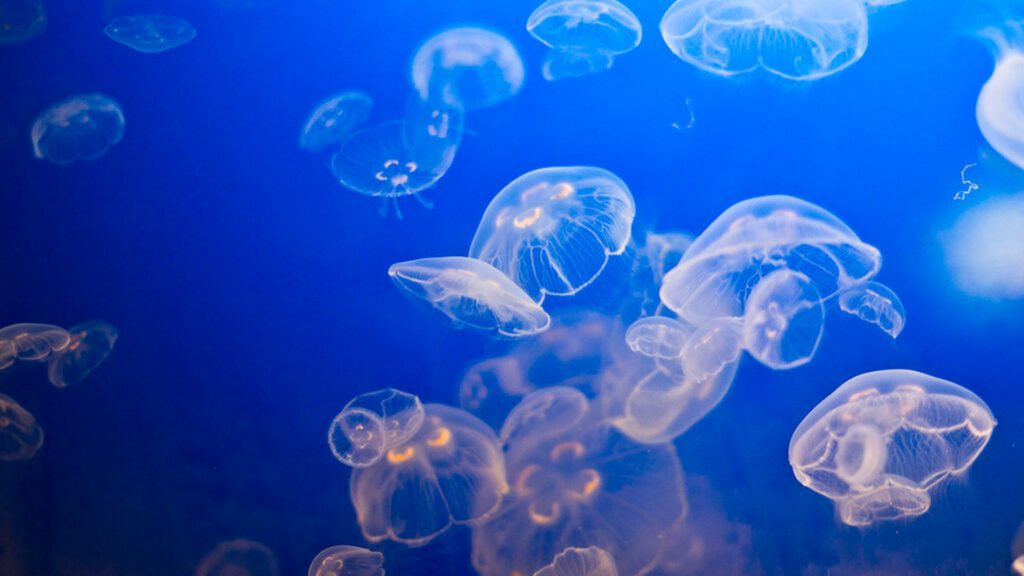
Moon JellyFish (Aurelia Aurita)
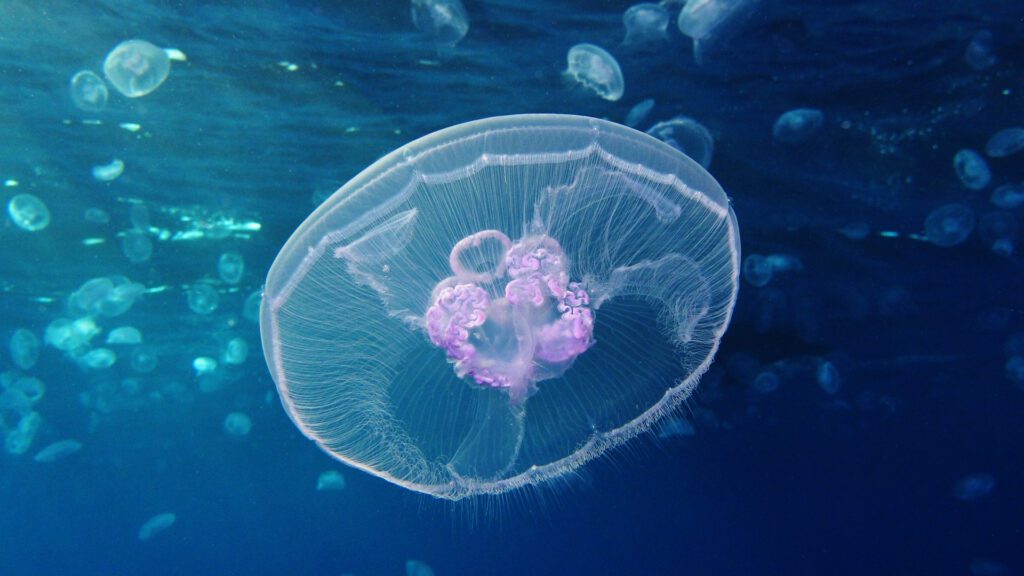
The moon jelly differs from many jellyfish in that it lacks long, potent stinging tentacles. Instead, it has hundreds of short, fine tentacles that line the bell margin. The sting does not affect humans.
With their translucent and bell-shaped bodies, they resemble delicate, floating moons in the water.
Though it has venom, it is harmless to humans—it’s even a popular dish in China!
|
Scientific Name | Aurelia Aurita |
|
Regions Found In | These jellyfish are frequently encountered in coastal regions globally, and one can often spot sizable gatherings while snorkeling in Maui, Hawaii. |
|
Size | Length – up to 16 inches (40 cm), Bell size – up to 12 inches (30 cm) in diameter. |
|
Venomous Rating | Very Low |
| Characteristics & Features |
|
Mushroom JellyFish (Rhopilema Verrilli)
Rhopilema verrilli, or mushroom cap jellyfish, is a species of jellyfish in the family Rhizostomatidae.
The species does not have any tentacles; however, they still have stinging cells, called nematocysts, within their bells, which can produce mild stings to humans.
This jellyfish gets its name from its unique umbrella-shaped bell, which resembles the cap of a mushroom.
While its venomous rating is generally considered low, caution should still be exercised to avoid direct contact with its tentacles.
|
Scientific Name | Rhopilema Verrilli |
|
Regions Found In | Indo-Pacific region |
|
Size | It can grow up to 20 inches in diameter. |
|
Venomous Rating | Moderate |
| Characteristics & Features |
|
Immortal Jellyfish
The Immortal Jellyfish, or Benjamin Button Jellyfish, is a jellyfish species that has fascinated scientists.
What makes this jellyfish truly extraordinary is its unique ability to revert its cells back to their earliest form, essentially reversing the aging process and enabling it to achieve potential immortality. This is one hell of an interesting topic, but it is entirely different from the one we are discussing today. Hopefully, we will get into this some other day!
|
Scientific Name | Turritopsis dohrnii |
|
Regions Found In |
The Mediterranean Sea
|
|
Size | Length – up to 0.18 inches (0.5 cm), Bell size – very small, less than 0.1 inch (0.3 cm) in diameter. |
|
Venomous Rating | Non-Venomous |
Venomous Jellyfish Species In The Ocean
Now that we have discussed the safe ones, it is also my job to make you aware of the ones humans should avoid strictly. Especially scuba divers! Here are some of the most prominent names.
Box Jellyfish (Chironex Fleckeri)
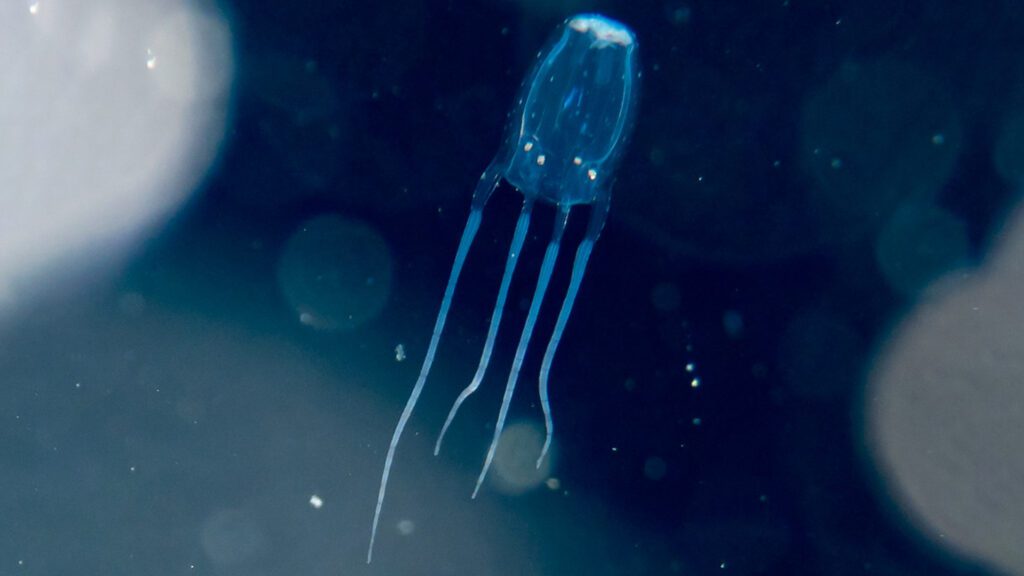
Its distinguishing feature lies in its thick, bootlace-like tentacles that can stretch up to an impressive length of 10 feet.
These long tentacles are armed with extremely venomous cells called nematocysts, making encounters with this species potentially fatal.
Portuguese Man-of-War (Physalia Physalis)
The man-of-war does not actively attack humans and is commonly out in open ocean water, far away from most human contact.
However, they can sometimes be found in relatively shallow coastal waters. If you come into contact with one of its tentacles while swimming, you may get a painful sting from the nematocysts.
Irukandji Jellyfish (Carukia Barnes)
Despite its small size, this jellyfish packs a punch with its venomous sting, which can cause Irukandji syndrome, an intense and potentially life-threatening reaction in humans.
It is important to note that encounters with the Irukandji Jellyfish are rare, and prompt medical attention should be sought if stung.
Sea Wasp (Chironex yamaguchii)
Beware the Sea Wasp, for it is one of the most venomous jellyfish in the world. With its translucent bell and long, tentacle-like appendages, this creature strikes fear into the hearts of swimmers. Found in the waters of the Pacific Ocean, encounters with this jellyfish can be extremely dangerous.
In severe cases, a single encounter with the Sea Wasp can result in excruciating pain, skin welts, and even cardiac arrest.
Protection Is Still Important
Yes, you can go near the non-harmful ones, but take some precautions nonetheless. If you ever do get stung by any of the non-venomous ones, take proper first aid immediately.
This includes plucking away any tentacles that may still be on the skin, taking a hot shower or applying a heat pack, rinsing the area with vinegar, and taking painkillers until the pain subsides.
| Extra Advice: Familiarize yourself with the types of jellyfish that inhabit the area where you will be swimming or engaging in water activities. Understand their habits, preferred habitats, and peak seasons to be more aware of potential encounters. |